Food & Drink
Budapest Dining Etiquette, Reservations and Tipping
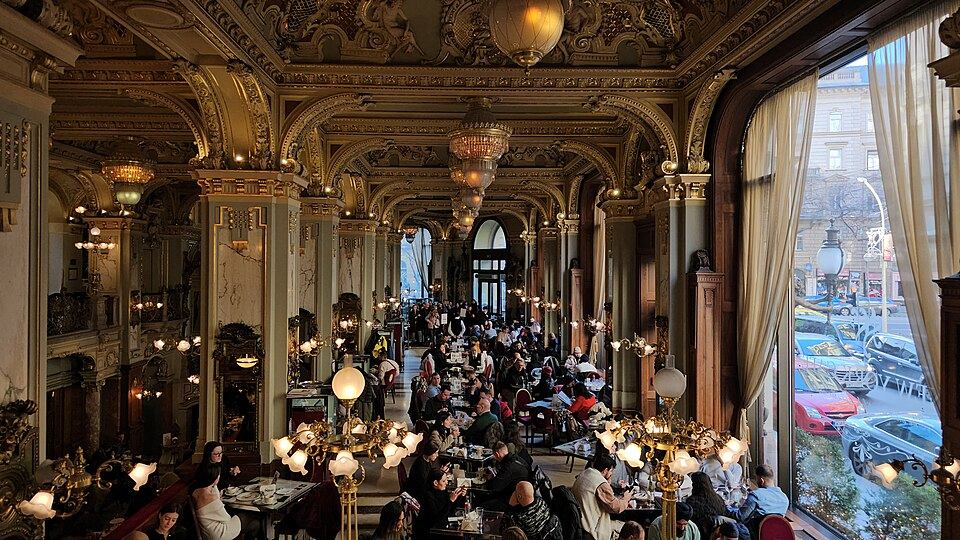
Photo: Asif Masimov via Wikimedia Commons, CC BY 3.0

At a Glance
- A service charge is sometimes already included in the bill in Budapest, so check before adding a separate tip on top.
- Tipping in cash directly to your server is common practice, even when the bill is paid by card.
- Reservations are advisable for popular or higher-end restaurants, especially on weekend evenings.
- Waving down a server for the bill is normal — tables aren't rushed, and nobody will bring it unprompted.
- Splitting a bill item by item is less common here than many visitors are used to; it's usually easier to divide the total evenly.
In this guide
- How Tipping Actually Works in Hungarian Restaurants
- Service Charges vs. Tips: Reading the Bill Carefully
- Reservations: When You Need Them and When You Don't
- The Pace of a Hungarian Restaurant Meal
- Cash, Card, and Common Billing Mix-Ups
- Ordering and Communicating Dietary Needs
- Menu and Bill Vocabulary That Prevents Surprises
- How Ordering Works: Drinks, Water and Portions
- Which Kind of Place Are You Walking Into?
- Quick Reference: What to Do in Common Situations
Dining out in Budapest follows a different rhythm than many visitors are used to, from how the bill works to how quickly, or slowly, a table turns over. None of it is complicated once you know the basics, but a few habits that are automatic at home can create real confusion at a Hungarian restaurant if you don't expect them.
How Tipping Actually Works in Hungarian Restaurants
Tipping in Hungary is customary but more modest than what many visitors are used to, generally landing in a range closer to what you'd leave for solid, unremarkable service at home rather than the higher percentage some visitors default to. It's typically handled in cash, even if you paid the main bill by card, and handed directly to the server rather than left on the table. Exact norms shift slightly depending on the type of restaurant, so treating it as a flexible gesture rather than a fixed formula is the right mindset.
Service Charges vs. Tips: Reading the Bill Carefully
Some restaurants, particularly larger or more tourist-oriented ones, already add a service charge to the bill, which should be itemized clearly if it's there. This matters because tipping on top of an existing service charge isn't required the way it would be if no charge had been added, and double-tipping without realizing it is an easy mistake. Always take a moment to actually read the bill line by line rather than assuming it works the same way as a restaurant back home.
Reservations: When You Need Them and When You Don't
Casual restaurants, market-hall food stalls, and most lunch spots don't require reservations and operate on a walk-in basis. Higher-end restaurants and popular spots in the city center, especially on Friday and Saturday evenings, are a different story, and booking a day or more ahead is a reasonable precaution if you have a specific place in mind. If you're still deciding what to prioritize, the general breakdown of what a Budapest trip costs is a useful companion for figuring out how much of your budget to put toward dining out versus other parts of the trip.
The Pace of a Hungarian Restaurant Meal
Meals tend to move more slowly than many visitors are used to, and nobody will bring your check unprompted the way a server rushing toward table turnover might at home. This isn't neglect, it's the norm, and the correct response is simply to make eye contact and ask for the bill when you're ready rather than waiting for it to appear. The same unhurried pace applies to Budapest's historic coffeehouses, in case you were wondering whether that slower rhythm extends beyond dinner.
Cash, Card, and Common Billing Mix-Ups
Most restaurants in tourist-frequented areas accept cards without issue, but smaller, more traditional spots can be cash-only in ways that aren't always obvious until the bill arrives. Carrying some forint in cash is a reasonable habit regardless of where you're eating, both for tipping and as a backup if a card terminal is down or unavailable.
Ordering and Communicating Dietary Needs
Learning a few basic Hungarian phrases for ordering and describing dietary restrictions goes a long way, even in restaurants where staff speak English well, since it signals effort and tends to get a more attentive response. The guide to useful Hungarian phrases and cultural etiquette covers more of this ground, and it pairs naturally with knowing the names of the Hungarian foods worth trying in Budapest so you're not ordering blind.
Menu and Bill Vocabulary That Prevents Surprises
Most menus in the central districts have English translations, but the bill is where a few Hungarian words pay off. Learn these and you can read almost any receipt.
| Word | Meaning | Why it matters |
|---|---|---|
| Étlap | Menu | Ask for it by name if you are handed only the drinks list |
| Napi menü | Daily set menu, usually a weekday lunch offer | A multi-course lunch priced as one item; it is the best-value way to eat at a sit-down restaurant at midday |
| Szervízdíj | Service charge | If it appears on the bill, you have already tipped |
| Fedezeti díj or kuvert | Cover charge | Occasionally added at some venues; check the menu footnotes |
| Borravaló | Tip | The word you may hear when a server asks if you want to add one |
| Számla or nyugta | Invoice or receipt | You should receive one with payment; keep it until you leave |
To ask for the bill, say "Fizetni szeretnék" (I would like to pay) or "Kérem a számlát" (the bill, please). Servers often ask whether you pay together or separately; "Együtt" means together and "külön" means separately. Answer that question before the terminal appears, since splitting is far easier when the server knows in advance.
How Ordering Works: Drinks, Water and Portions
Drinks follow their own measurements. Wine by the glass is often listed per deciliter, abbreviated dl, so a "1 dl" glass is smaller than a U.S. pour; beer is typically 0.3 or 0.5 liters; and spirits like pálinka (a fruit brandy) are served in small measures. A very Hungarian order is a fröccs, wine mixed with soda water: a kisfröccs uses 1 dl wine with 1 dl soda, and a nagyfröccs uses 2 dl wine with 1 dl soda. It is a normal summer drink, not a downgrade of the wine. Cheers are "Egészségedre," or "Egészségünkre" when you say it for the whole table.
Water is its own conversation. Budapest's tap water is drinkable, and you can request it as csapvíz, but many restaurants bring bottled water by default and charge for it. If you want bottled, specify szénsavas for sparkling or szénsavmentes for still. Some fish dishes, and occasionally steaks, are priced by weight per 100 grams, so ask for the weight and total before you order if you see a per-gram price rather than a dish price.
Portion sizes at traditional restaurants lean generous, and many mains arrive with a side included. Starters and soups are meaningful courses, and sharing is common. If you are building a meal around regional dishes, the Hungarian foods guide explains what to expect from each plate.
Which Kind of Place Are You Walking Into?
The Hungarian label on the door tells you more about etiquette than the decor does. Use the table to adjust how you order, how formal to dress, and how you handle payment.
| Type | What it is | Service and tipping norm | Reservation advice |
|---|---|---|---|
| Étterem | Full-service restaurant | Table service; tip or check for a service charge | Book for weekend dinners |
| Vendéglő | Traditional inn-style restaurant with home-style dishes | Relaxed table service; tip modestly in cash | Often useful in the evening, less so at lunch |
| Kifőzde or étkezde | Simple lunch canteen with daily dishes | Often counter ordering; tipping is optional | None; arrive early because dishes sell out |
| Borozó | Wine bar or cellar | Order at the table or bar; small tips are a courtesy | Rarely needed except for groups |
| Kávéház or cukrászda | Coffeehouse or pastry shop | See the coffeehouse guide; round up for table service | Not usually |
Handling Tips When You Pay by Card
Because card terminals often do not offer a tip line, the practical method is to tell the server the total you want to charge, tip included, at the moment they bring the terminal. Say the full amount aloud and they will enter it. A commonly cited range for table service is roughly 10 to 15 percent, and where a service charge of a similar size is already printed, an extra tip is a courtesy rather than an obligation. In cash, hand over the money and say the total you want to pay, so the server knows how much change to return and what is meant as the tip. Check the final receipt for the printed total before you sign or tap, and keep it in case there is any dispute. Bar and counter service is a different category: a small coin tip is welcome but never assumed.
Quick Reference: What to Do in Common Situations
| Situation | What to Do |
|---|---|
| Bill already includes a service charge | A smaller additional tip is optional, not required |
| No service charge listed | Leave a modest cash tip directly with your server |
| Want to split a bill with a group | Dividing the total evenly is simpler than itemizing |
| Ready to leave | Make eye contact and ask for the bill — it won't come automatically |
| Weekend evening at a popular restaurant | Reserve ahead rather than walking in |
Common Mistakes to Avoid
- Tipping a full 20 percent out of habit without checking whether a service charge is already included in the bill.
- Waiting for the check to be brought automatically — in most Hungarian restaurants, you need to ask for it.
- Showing up without a reservation to a popular restaurant on a weekend evening and being surprised by a long wait or no table at all.
- Assuming every restaurant takes cards — some smaller, traditional spots are cash-only.
Frequently Asked Questions
Do you tip in Budapest restaurants?
Yes, tipping is customary, though typically at a more modest rate than many visitors are used to. Check the bill first, since a service charge is sometimes already included.
Is tipping expected in cash or can I add it to a card payment?
Cash is the more traditional and reliable method, handed directly to your server, even if the main bill is paid by card. Some restaurants allow adding a tip to a card payment, but it's not universal.
Do I need a reservation for dinner in Budapest?
For casual restaurants and lunch spots, no. For popular or higher-end restaurants, especially on weekend evenings, a reservation is a sensible precaution.
Why hasn't my server brought the bill yet?
It's not an oversight — tables generally aren't rushed, and the bill is brought when you ask for it, not automatically after the meal ends.
Is it okay to ask for substitutions or modifications to a dish?
Yes, this is generally fine and common, especially in restaurants used to international visitors, though very traditional kitchens may have less flexibility with set recipes.
What does szervízdíj on my bill mean, and do I tip on top of it?
It means a service charge has been added, so you have effectively already tipped. Leaving a little extra for exceptional service is a courtesy, not a requirement, while ignoring a printed charge to tip separately would double up.
What is a fröccs and is it normal to order one?
A fröccs is wine mixed with soda water, and it is a regular, everyday Hungarian drink. A kisfröccs is 1 dl of wine with 1 dl of soda, and a nagyfröccs is 2 dl of wine with 1 dl of soda. Asking for one at a casual place is entirely normal.