Food & Drink
Budapest Coffeehouse Culture: History and Places to Explore
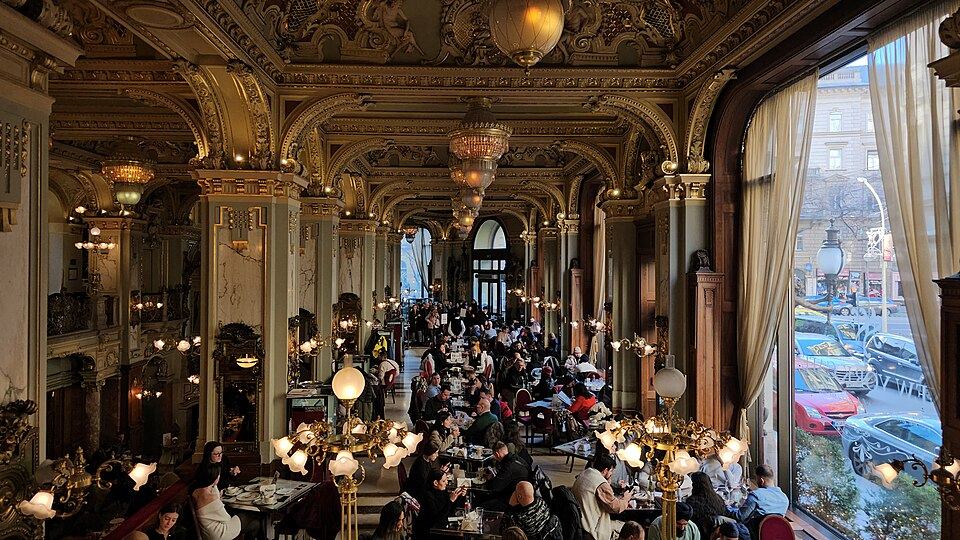
Photo: Asif Masimov via Wikimedia Commons, CC BY 3.0

At a Glance
- Budapest's kavehaz tradition dates to the late 1800s, when cafes doubled as informal offices for writers, journalists, and political debate.
- New York Cafe is the most famous historic coffeehouse, known for its elaborate painted interior rather than for a quiet atmosphere.
- Ordering a single coffee and sitting for an hour or more is culturally normal, not something you need to feel rushed about.
- Several historic cafes survived decades of political change and still operate in their original buildings today.
- Cakes like Dobos torte and strudel are as central to the coffeehouse experience as the coffee itself.
In this guide
- Where Budapest's Coffeehouse Culture Comes From
- New York Cafe and the Golden Age of the Kavehaz
- What Makes a Kavehaz Different From an Ordinary Cafe
- Historic Cafes Worth Knowing
- What to Order: Coffee, Cake, and Beyond
- Coffeehouse Etiquette: Pacing, Seating, and the Bill
- Where Coffeehouse Culture Fits Into a Visit
Coffee in Budapest carries a cultural weight it doesn't have in most cities, rooted in a late-19th and early-20th-century tradition where cafes functioned as reading rooms, meeting halls, and informal workspaces for writers and journalists. That history still shapes how several of the city's grand historic cafes operate today, even though the clientele has shifted toward visitors as much as regulars. Understanding where that tradition came from makes a stop at one of these cafes feel like more than just a coffee break.
Where Budapest's Coffeehouse Culture Comes From
By the late 19th century, Budapest had hundreds of coffeehouses, many of them central to the city's literary and political life. Writers without office space or a reliable income used certain cafes as a base, reading newspapers, writing, and debating for the price of a single coffee, a practice cafe owners largely tolerated because a full room signaled status. That culture was badly disrupted across the 20th century by war and decades of state control, and only a handful of the grand original cafes made it through to the present in anything like their original form.
New York Cafe and the Golden Age of the Kavehaz
New York Cafe, opened in 1894, is the most visually dramatic survivor of that era, with gilded columns, frescoed ceilings, and a scale that was meant to impress from the moment it opened. It was a genuine literary hub in its early decades, known for writers and editors who treated it as a second office. Today it operates as a formal, higher-cost cafe and restaurant rather than a casual stop, and it's worth visiting specifically for the room itself as much as for what's on the menu.
What Makes a Kavehaz Different From an Ordinary Cafe
A traditional kavehaz is built around slow, extended seating rather than quick turnover, with marble tables, formal waitstaff, and a menu that includes both coffee and a proper food and pastry selection. It's closer in spirit to a Viennese grand cafe than to a quick modern coffee shop, and the pace reflects that: nobody expects you to order and leave quickly.
Historic Cafes Worth Knowing
A handful of cafes carry most of the historical weight, and knowing roughly what each is known for helps you choose where to stop:
| Cafe | Known For | General Area |
|---|---|---|
| New York Cafe | Elaborate 1894 interior, literary history | Erzsebetvaros |
| Gerbeaud | Historic confectionery and cakes since the 1850s | Central Pest, Vorosmarty Square |
| Central Kavehaz | Former hub for writers and journalists | Central Pest |
| Muvesz Kavehaz | Classic cafe near the Opera House | Near the State Opera |
What to Order: Coffee, Cake, and Beyond
A straightforward black coffee is usually ordered as an "eszpresszo," while a milkier option closer to a cappuccino is common on most menus under its own name. Cake is just as central as the coffee: Dobos torte and retes (strudel) appear on nearly every historic cafe's dessert case, alongside regional specialties that vary by cafe. Many of the same desserts also appear more broadly across the city's traditional Hungarian food, so a cafe stop doubles as a dessert-focused extension of that list.
Coffeehouse Etiquette: Pacing, Seating, and the Bill
Lingering over a single coffee for an hour or more is normal and not considered taking advantage of the table, which is part of the original point of these cafes. Table service is standard — you generally wait to be seated and ask your server for the bill rather than paying at a counter — and tipping follows roughly the same patterns as a regular restaurant meal, which the guide to Budapest dining etiquette and tipping covers in more detail.
Where Coffeehouse Culture Fits Into a Visit
Several of the grandest cafes sit close to major landmarks, which makes them easy to combine with sightseeing rather than requiring a separate trip. A stop near St. Stephen's Basilica or an evening built around a concert or opera performance both pair naturally with a historic cafe nearby, since several of the best-known rooms are a short walk from both.
Common Mistakes to Avoid
- Treating a historic cafe like a quick coffee-shop stop — rushing the experience misses the point of the slower, sit-down format.
- Expecting New York Cafe's prices to match a neighborhood coffee shop — it's priced closer to a formal restaurant because of the setting and service.
- Skipping dessert because you already ate — cake is often the main reason to visit a historic cafe, not an afterthought.
- Assuming every "cafe" in the city has this historic character — many modern coffee shops are just that, with no connection to the kavehaz tradition.
Frequently Asked Questions
Do I have to order food to sit down at a historic cafe?
No. A single coffee is traditionally enough to justify a seat for an extended period, which is part of the original culture of these cafes, though you'll get more out of the visit by trying a pastry too.
Is New York Cafe worth the higher price?
Many visitors find it worthwhile specifically for the interior, which is one of the most elaborate cafe rooms in Europe. If the price feels steep, treat it as a sightseeing stop rather than a regular coffee break, and visit other historic cafes for a more moderate option.
What's the difference between a kavehaz and a regular coffee shop?
A kavehaz is built around slow, seated, full-service dining with a formal food and pastry menu, while a regular coffee shop is designed for faster turnover and often counter service.
Are these cafes still used by locals, or mainly tourists?
It varies by cafe. Some of the most famous rooms, like New York Cafe, draw mostly visitors today, while others retain a more mixed local and tourist crowd, especially outside peak hours.
Do I need a reservation for a historic cafe?
Reservations aren't typically required for a coffee, but the most visually dramatic cafes can have a wait at peak times, so arriving outside the busiest midday and early-evening hours helps.